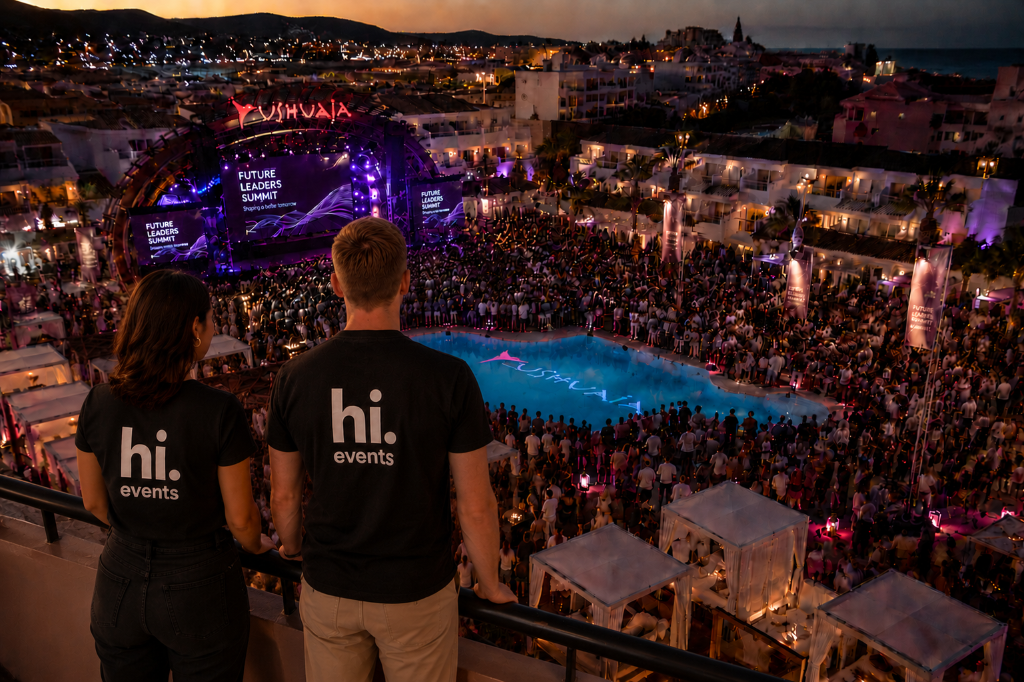
Strategic corporate events designed around what comes next.
We are not simply event planners. We are strategic event partners. Every event should answer one question: what should be different after this event than before it?
Most event planning begins with logistics. A venue is booked, a date is set, a supplier list is drawn up and an agenda is built around the available time. Strategic corporate events begin somewhere else entirely. They begin with the question that matters most: what should be different after this event than before it? The answer to that question shapes everything that follows, from the format and the guest list to the hospitality and the follow-up. The event management is simply the mechanism through which the strategy is delivered.
Why businesses invest in events.
Organisations invest in events because relationships are their most valuable asset, and events remain one of the most effective ways to build them. A well-run email campaign keeps a relationship warm. A quarterly review keeps a client informed. But genuine trust, the kind that makes a client call you first, a partner advocate for you internally or a colleague volunteer an idea they had been holding back, is built far more quickly in person than it ever is through a screen.
The businesses that understand this are the ones that treat events as an investment in relationships rather than a line item in a budget. Professional services firms use events to stay close to clients between transactions. Technology companies use events to build community and authority in competitive markets. Financial organisations use events to nurture investor relationships that unfold over years rather than quarters. In every case, the event is not the product. The relationships it creates are.
This is why the measure of a successful corporate event is never simply how smoothly it ran or how impressive the venue looked. The measure is what happened to the relationships in the room, and what continued to happen in the weeks and months that followed. An event that produces no deeper relationships, no warmer conversations and no commercial momentum is an event that was never designed to deliver value, regardless of how well it was executed.
The psychology behind successful events.
Successful events are not accidents. They are the result of hundreds of decisions that most guests never consciously notice, each one shaped by an understanding of how people actually behave in shared spaces. Lighting changes mood. Seating influences interaction. The pace of a day affects the quality of discussion. The atmosphere guests walk into tells them who the host is long before anyone steps onto a stage.
People remember how an event made them feel far more than they remember what was said. This is why two events with identical agendas can produce completely different outcomes. One creates energy and connection; the other fills time and is forgotten by Monday. The difference is rarely the content. It is the environment, the pacing, the hospitality and the space left for the conversations that were never on the agenda but turned out to matter most.
Understanding this is what separates a strategic event partner from a logistics provider. It is knowing when to create energy and when to create calm. It is leaving room for a conversation to continue naturally rather than rushing into the next item. It is designing an experience around human behaviour rather than around a timetable, because the moments people remember are almost never the ones that were scheduled.
Trust is built more quickly across a dinner table than it is across a hundred emails.
What a strategic corporate event actually is.
A strategic corporate event is an event designed around a defined business outcome. That outcome might be a deeper client relationship, a new partnership, stronger internal alignment, thought leadership positioning or commercial momentum. Whatever it is, it is defined before the venue is chosen, before the guest list is drawn up and before the agenda is built. Every decision that follows is measured against that outcome.
This does not mean events become transactional or over-engineered. The opposite is true. When the purpose is clear, the experience becomes more considered, more relaxed and more human. Guests are not shuffled through a programme designed to impress. They are welcomed into an environment designed to connect them, where every detail, from the welcome to the seating to the hospitality, serves the relationships the event exists to build.
The strategic element is invisible to the guest. What they experience is an evening that felt effortless, a conference where conversation flowed naturally or a dinner where they met exactly the right people. That sense of ease is not accidental. It is the result of strategy applied with restraint, where the planning disappears into the experience.
Relationship building as the core mechanism.
Behind every successful organisation is a network of relationships that has been built carefully over time. Behind every contract is trust. Behind every opportunity is a conversation. Strategic corporate events exist to accelerate the development of those relationships in a way that almost no other format can match.
Relationships are built through shared experience. A conversation over a meal, a discussion that runs past its allotted time, a moment of genuine laughter between people who have only ever met on a call, these are the interactions that turn contacts into relationships and relationships into partnerships. Events create the conditions for these moments to happen, not by forcing them but by designing environments where they occur naturally.
This is why the guest list, the format and the flow of an event matter so much. The right people in the right environment with the right atmosphere will find each other. The job of a strategic event partner is to create that environment and then get out of the way, allowing the relationships the event was designed to build to form on their own terms.
Guest experience and the feeling people remember.
Guest experience is the feeling people carry with them after an event. It is not the venue, the food or the entertainment in isolation. It is the cumulative impression left by every interaction, from the moment a guest receives the invitation to the moment they leave and, crucially, the days that follow. When that experience is considered and intentional, guests leave feeling valued. When it is not, they leave having attended an event.
The details that shape guest experience are often the ones that go unnoticed when they are right and are glaringly obvious when they are wrong. A welcome that makes someone feel expected. Seating that removes the awkwardness of not knowing where to sit. A pace that allows conversations to breathe. Hospitality that reflects an understanding of who is in the room. Each of these is a decision, and each one communicates something about the host.
Great guest experience does not require a large budget. It requires thought. A modest room where every guest feels personally looked after will always outperform a spectacular one where they feel like an afterthought. This is the principle that guides every event we deliver, because the experience guests remember is the one where they felt it was designed around them.
Hospitality is making people feel thought about.
Hospitality is often mistaken for serving food and drinks. To us it is something deeper. It is the act of making people feel that somebody considered their experience before they arrived. It is remembering preferences, anticipating needs and removing friction before it exists. It is ensuring nobody feels like an outsider and nobody spends an evening wondering why they were invited.
Good hospitality is quiet. It does not announce itself. It simply ensures that everything works, that people are comfortable and that the experience feels personal rather than managed. When hospitality is done well, guests do not think about it. They simply feel looked after, and that feeling is what they remember and what they associate with the organisation that hosted them.
This extends to every part of the experience, including the details many organisations dismiss as insignificant. We have never understood why people accept average food simply because it is served at an event. Food creates conversation. It brings people together. It tells guests how much they were valued. Why settle for forgettable catering when the meal itself could become one of the most memorable parts of the experience?
The welcome says whether people belong. The venue says what you value. The atmosphere tells people who you are.
Why human connection is the real deliverable.
There has never been a time when we have been more connected, yet felt so disconnected. We exchange thousands of messages, attend countless online meetings and consume more content than any generation before us. We can reach almost anyone in seconds, yet genuine conversation has quietly become something we experience less and less. Events are one of the last opportunities to bring people together with intention.
When people leave an event with stronger relationships than they arrived with, the event has already delivered its greatest return on investment. Sometimes that connection becomes a new client. Sometimes it becomes a new idea. Sometimes it is simply the reassurance that someone is not facing a challenge alone. In every case, it is the human connection that creates the value, not the agenda.
This is why we design every event around the relationships it exists to build. Not because connection is a marketing theme, but because it is the actual mechanism through which events create lasting value. An event that brings the right people together in the right environment will produce outcomes that no email sequence, no advertising campaign and no presentation deck ever could. Read more about this in our Human Connection Manifesto.
Creating measurable ROI from corporate events.
The challenge with measuring event ROI is that the most valuable returns rarely arrive with a receipt. They show up in the client who calls with a question they would not have thought to ask, the introduction that leads to a partnership, the senior stakeholder who returns a call a little faster because they met the team in person. These outcomes are real, measurable in their effect and often worth many times the cost of the event, but they do not fit neatly into a spreadsheet on the Monday after.
Creating measurable ROI begins with defining what success looks like before the event is planned. For a client-facing event, that might be a target number of qualified conversations, a specific relationship to deepen or a commercial opportunity to open. For an internal event, it might be cross-departmental alignment, a decision that needs to be made or a culture shift that needs to begin. For a thought leadership event, it might be positioning, press coverage or the beginning of conversations with a new audience.
Once the outcomes are defined, the event can be designed around them and the follow-up planned before the event takes place. The organisations that consistently generate ROI from events are the ones that treat the event as the beginning of something, not the end. The conversations that start at the event are nurtured in the weeks that follow, and the value compounds over time rather than evaporating the moment the venue is cleared.
Post-event impact: where the real value lives.
An event is not a moment. It is the start of a period of impact that unfolds over weeks and months. The dinner that leads to a client briefing the following Thursday. The conference introduction that becomes a partnership six months later. The leadership retreat decision that reshapes how a team operates for the next year. These are the outcomes that justify the investment, and they only happen when the event was designed to produce them.
Post-event impact is the difference between an event that was enjoyed and an event that mattered. Enjoyment fades. Impact compounds. The event that produces ongoing conversations, deeper relationships and commercial momentum is the one that was planned with the aftermath in mind, not just the evening itself.
This is why we plan the follow-up before the event takes place. Who needs to be introduced afterwards? Which conversations need nurturing? What should happen in the two weeks after the event to ensure the relationships it built continue to develop? When these questions are answered in advance, the event becomes a catalyst rather than a memory, and the value it creates continues long after the last guest has left.
Measuring success when the outcomes resist spreadsheets.
If success is measured only by attendance, satisfaction scores and social media reach, every well-produced event looks successful. The problem is that these metrics tell you very little about whether the event achieved anything that mattered. A full room of satisfied guests who never speak to each other again is not a strategic success. It is a social occasion.
Measuring the success of a strategic corporate event requires looking at what changed because of it. Did the client relationships it was designed to deepen actually deepen? Did the conversations it was designed to start actually start? Did the commercial opportunities it was designed to open actually open? These questions can be answered, but only if they were asked before the event was planned.
We work with clients to define what success looks like in advance, then track both the immediate signals and the outcomes that unfold afterwards. Sometimes the evidence is quantitative: meetings booked, deals advanced, partnerships formalised. Sometimes it is qualitative: a warmer tone in client conversations, a faster response from a senior stakeholder, a team that collaborates more openly. Both matter, and together they tell the real story of whether the event delivered.
Where strategic corporate events go wrong.
The most common mistake is choosing a venue before defining the purpose. A spectacular venue may be perfect for a client reception but entirely wrong for a strategic leadership dinner. When the venue drives the event rather than the purpose, the format, the guest experience and the outcomes are all shaped by a decision that should have come later in the process.
The second mistake is confusing production value with event quality. A beautifully produced event with no clear purpose will impress guests for an evening and be forgotten by Monday. Production should serve the purpose, not replace it. This is the difference between event production as a strategic tool and event production as spectacle, and the distinction matters enormously for return on investment.
The third mistake, and the one that costs the most, is neglecting the follow-up. An event that produces no ongoing conversations, no deeper relationships and no commercial momentum is an event that was never designed to deliver ROI. The event is the beginning of something, not the end. The organisations that understand this are the ones whose events consistently produce value long after the venue has been cleared.
What should be different after this event than before it?
This is the question we ask at the start of every engagement, and it is the question every organisation should ask before investing in a corporate event. If the answer is nothing more than people had an enjoyable evening, the event has missed its opportunity. If the answer involves stronger client relationships, warmer conversations, new partnerships, better internal alignment or commercial momentum, then the event has done what strategic corporate events are designed to do.
The events that create lasting value are not the ones with the largest budgets or the most impressive venues. They are the ones that were designed with intention, where every detail served a purpose and where the experience was shaped around the relationships the event existed to build. These are the events people remember, not for what happened but for what they led to.
That is the standard we hold ourselves to. Not more events, but better reasons to bring people together. If you are planning a corporate event and want it to be designed around outcomes rather than logistics, we would like to hear from you.
How we put this into practice.
Related cornerstone topics.
If this resonates, let's talk.
We help organisations design strategic corporate events around the relationships and outcomes that matter most.
Strategic corporate events, answered.
Common questions about working with a strategic event partner.