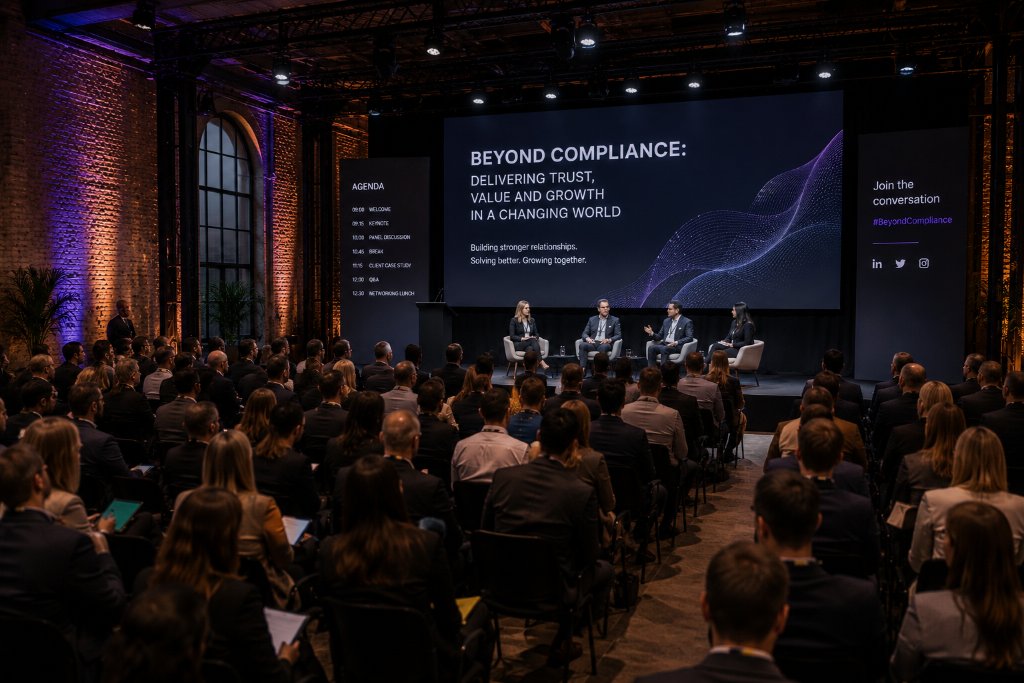
A great conference doesn't fill seats. It shapes conversations.
Most conferences are planned as programmes to be endured. The ones that matter are designed as experiences that change how people think about your industry.
Conferences occupy a strange place in the corporate event landscape. They're among the most expensive and logistically complex events an organisation can produce, yet they're often the least strategically designed. Sessions are scheduled, speakers are booked, AV is arranged - and the result is a programme that fills a day but rarely changes anything. The difference between a conference that fills seats and one that shapes conversations lies entirely in how it's planned.
Why Most Conferences Fail
Most conferences fail for the same reason: they're designed as programmes rather than experiences. The planning process starts with content - what topics will be covered, who will speak, what time the sessions are - and treats the audience as passive recipients of information rather than participants in a conversation.
The result is predictable. Energy peaks during the first session and declines steadily thereafter. The networking breaks are too short or too crowded. The catering becomes the highlight. By the final session, half the audience has left, and those who remain are checking their phones. Nobody walks away thinking differently, and the organisation that hosted the conference has spent significant money to produce forgettable content.
The conferences that succeed - the ones that build authority, create commercial momentum and leave attendees talking for months - are planned differently. They start not with content but with the audience.
The conferences that succeed are planned not as programmes but as experiences.
Designing a Conference Around the Audience
Strategic conference planning begins with a simple question: who is in the room, and what do they need from this experience? The answer shapes everything - the format, the agenda cadence, the networking design, the hospitality, the production. When the audience is the starting point, the content serves the audience rather than the other way around.
Editorial agenda design is central to this approach. Rather than simply filling slots with speakers, a strategic conference planner shapes the rhythm of the day - balancing high-energy sessions with quieter moments, mixing formats to maintain attention, ensuring that every session builds on the one before it. Speaker transitions, break scheduling and room flow are all designed to keep energy high and attention focused.
Designed networking spaces matter just as much as the content. The most valuable moments at any conference tend to happen in the gaps - the conversation that starts in the coffee queue, the introduction made in the lounge, the insight shared between sessions. A well-planned conference builds in space for those moments rather than packing every minute with content.
Where Production Meets Experience
Conference production is where strategy meets execution. The stage design, the AV, the lighting, the sound engineering - these aren't just technical requirements. They're the elements that determine whether the content lands or falls flat. A brilliant speaker with poor acoustics is wasted. A powerful presentation with inadequate screens is diminished. Production quality is the difference between content that resonates and content that's merely endured.
We manage every layer of conference production - stage design, AV, lighting, sound engineering, set build, livestreaming, hybrid support, interactive technology - ensuring that the technical infrastructure serves the content rather than competing with it. When the production is invisible, the content can do its work.
For multi-day conferences, the production challenge multiplies. Session transitions, speaker management, delegate flow between rooms, catering coordination, accommodation - every layer requires proactive coordination and rapid problem-solving. The success comes from the ability of multiple teams to operate as one streamlined unit.
What a Well-Planned Conference Creates
A strategically planned conference positions your organisation as an authority within your industry. It creates the conditions for strategic relationships to form. It delivers clearer messages, generates useful conversations and produces content that can be repurposed long after the event ends.
Most importantly, a well-planned conference changes how people think about your organisation. They don't remember the agenda, but they remember the feeling - of being engaged, of being part of something, of having their time respected. That feeling quietly shapes every subsequent interaction they have with your brand.
The conferences that deliver these outcomes aren't the ones with the biggest budgets or the most famous speakers. They're the ones that were planned with intention - where every decision, from the agenda to the acoustics, served a single purpose.
Essays that explore this further.
Related cornerstone topics.
If this resonates, let's talk.
We help organisations design events around the relationships and outcomes that matter.