How to Choose a Corporate Event Planner in London (And What to Ask Before You Sign)
- A good planner treats venue and production as means to an end, not the end itself. If the first conversation is about room capacity before your objectives, that's worth noticing.
- Ask how fees are structured: the planning fee should be separate from pass-through supplier costs, and both should be visible.
- Range of experience matters more than scale. A planner who's only done one size of event will default to what they know, whether or not it fits your brief.
- Budget should be built transparently once your objective is clear, with the planning fee kept separate from what you're paying suppliers directly.
Search "corporate event planner London" and you'll get a wall of agencies that all sound roughly the same: strategic, bespoke, award-winning. That sameness is the actual problem when you're trying to hire one. Here's what we'd tell a friend who asked us how to tell them apart, from the other side of the table, having run this kind of event for over 15 years.
What a corporate event planner in London is actually doing for you
Strip away the language, and the job has four real parts: turning a business objective into a guest experience that delivers it, sourcing and negotiating a venue that fits both the vision and London's particular constraints (business-district access hours, congestion charge zones, load-in restrictions on historic buildings), managing the supplier chain (catering, production, entertainment, transport) so nothing collides on the day, and running the room while you're free to actually host your guests instead of managing a clipboard.
The part worth paying attention to: a planner who's good at this treats the venue and the production as means to an end, not the end itself. If the first conversation is about room capacity before it's about what you're trying to achieve, that's worth noticing.
Questions worth asking before you hire one
Most agencies will tell you they're experienced and creative. Here's what actually separates them, and the answers we give when clients ask us directly.
How is your fee structured, and what's separate? A clear answer splits the planning and management fee, agreed before work begins, from venue, catering, production, travel and other supplier costs, which should be visible rather than folded in. If you can't get a straight answer on where the planner's fee ends and pass-through costs begin, that's worth pressing on.
What's the actual range of events you've run? Scale matters less than range. We've planned everything from a ten-person executive dinner to programmes for more than 2,000 guests, and the honest answer is that a planner who's only ever done one size of event will default to what they know, whether or not it fits your brief.
How far ahead do you need to start? As a rough guide: eight to twelve weeks is workable for an intimate dinner or reception, three to six months for a larger gathering, and six to twelve months for a major conference or a production-led programme, earlier still if you want first pick of London dates and venues. A planner who says "any timeline is fine" either has more flexibility than most, or isn't being straight with you about what good options disappear first.
Can you show me how you'd handle our brand or our sector specifically? This is where case studies matter more than credentials. Ask to see how a planner has handled something adjacent to your situation, not just their best photos.
What that range looks like in practice
A global AI technology company came to us needing to position itself as a thought leader on AI regulation while building genuine relationships with senior decision-makers. Not a typical brief, and not one that starts with "let's find a nice venue." We built the guest list and the room around that objective: 80 people, in a Bond Street jewellery showroom, with the format designed for conversation rather than a stage and a lectern.
A luxury brand's UK launch for Tom Ford Soleil Neige needed 250 guests to walk into an environment that felt like the product before anyone said a word about it: a different discipline entirely, closer to immersive brand design than traditional event logistics.
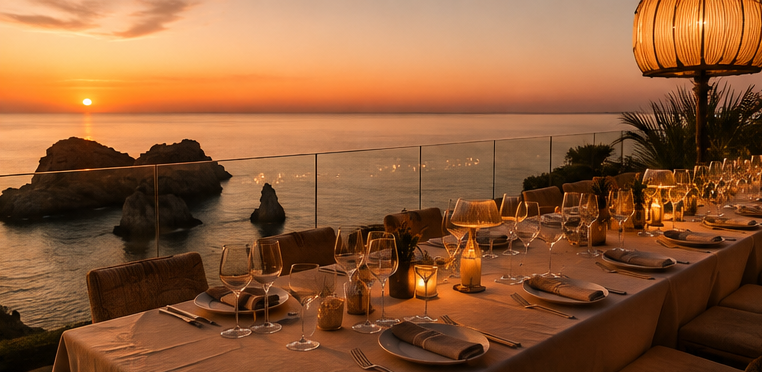
And a B Corp-certified company wanted its annual gathering to actually reflect the values it talks about the rest of the year, not just tick a "team offsite" box. That became a week-long programme in Ibiza for 130 people, built around genuine connection rather than a schedule of activities.
Three different objectives, three different formats, three different guest counts, and that's really the point. The venue and the production followed the brief, not the other way round.
A realistic sense of budget
There's no honest single number here, and any planner who gives you one without asking questions first is guessing. An executive dinner for ten and a multi-stage conference are different budgets by an order of magnitude: venue, guest numbers, food and drink, production, entertainment, travel, security and the overall level of experience all move the total. The useful exercise isn't finding an average, it's building a transparent working budget once your objective and priorities are clear, with the planning fee kept separate from what you're paying suppliers directly.
Where we work
We cover events across The City, Holborn, Mayfair, Westminster, Soho, Shoreditch, Canary Wharf, South Bank, Kensington and further across London, for professional services firms, financial organisations, technology companies, private offices and membership bodies who treat their gatherings as an investment in relationships rather than a marketing line item.
If you're at the stage of comparing planners rather than venues, get in touch. We're happy to talk through what you're trying to achieve before anyone mentions a room.